Contents
Author
Who is writing, and what was built.
I am Rahmad Dita, one of the people behind Akses. I work as a product person, which in my case has meant three jobs at once: product (deciding what to build and why), engineering (building it), and business operations (making it run every day).
Between 2016 and 2026 I built or rebuilt 17 products and businesses. Some as a product lead inside a company, some as a founder, some as the person who simply had to make it work.
| Category | What was built |
|---|---|
| Apps | Vehicle diagnostics for mechanics · restaurant discovery and booking · nearby pharmacy ordering · used car marketplace · doctor appointment booking · logistics pickup and drop · task management for teams spread across Indonesia · retail partner acquisition · operating software for MCU (medical check up) services, end to end |
| Hardware + app | Tools to help small retail partners raise revenue or cut cost |
| Clinics | Neurology · pediatric · general · company (in-house clinics for employees) |
| Food and farm | An aquaculture (fish farming) farm · a cafe · a small F&B (food and beverage) kiosk |
Not all of them worked. Some stalled, some failed, and the definition of success was different for each one. What they shared was the goal: reach product market fit (the point where a product clearly solves a real problem for people who will pay for it), then grow.
Why now
Why write this now: execution, impact, optics.
I once learned that a product person spends energy on three things. Execution is getting the work done. Impact is making sure the work actually moves something. Optics is making the work visible. Early in a career, almost all energy goes to execution. Slowly, the share shifts toward impact, and later toward optics.
For those ten years, almost all my focus went to execution or impact. Very little of it was ever told. This piece is optics getting a share.
Optics is not image-polishing. It is making work that already exists visible and usable for others. So the test for this piece is simple: it should leave you with something you can use.
- The industry is rarely the hard part. Across 17 products, the things that decided growth were almost the same every time.
- Five patterns kept coming back: go in yourself first, then delegate; one problem at a time; track what moves, not what looks good; systems outlast people; industries change, the questions don't.
- The mistake I repeated most was relying on people instead of building the system around them, and taking too long to replace the wrong person.
- A five-question self-check at the end helps you see which pattern your team is missing.
01Playbook
A playbook is not a pattern.
When people enter a new industry, the first thing they look for is a playbook: how do clinics grow, what do successful cafes do. It feels like the responsible move.
I did the same for years. Every time I entered a new field, I assumed the hard part was learning the industry. Most of the time it was not.
The difference gets mixed up a lot. A playbook is a list of moves that worked for someone else, in their situation. A pattern is the reason those moves worked. A playbook breaks when the industry changes. A pattern travels.
The customers across these 17 products had almost nothing in common: a mechanic, a parent with a sick child, a cafe regular, a small shop owner. Margins, regulation, and speed were all different. Yet when I put the ten years on one page and asked what actually decided growth, five things kept showing up.
Mobility
- Diagnostic app for mechanics
- Used car marketplace
Health
100K patients a year, clinics operated
- Nearby pharmacy app
- Doctor booking app
- Neurology clinicrevenue 2x capital, under 1 yr
- Pediatric clinic
- General clinic
- Company clinic
- MCU operating software
Retail
- Retail partner acquisition
- Partner revenue and cost tools
Logistics and teams
- Pickup and drop logistics apprevenue 9x in 1.5 yrs
- Distributed team task app
Food and farm
- Restaurant find and book app3M monthly active users
- Caferevenue 2x capital in under 6 mo
- Small F&B kiosk
- Aquaculture farm1x capital in 9 mo
Same questions
- 01
Go in yourself first, then delegate
- 02
One problem at a time
- 03
Track what moves, not what looks good
- 04
Systems outlast people
- 05
Industries change, the questions don't
02Patterns
The five patterns.
01Go in yourself first, then delegate
What it means: before you hand a process to someone else, get close enough to it to know what good looks like. That does not mean doing everything alone. It means being hands-on in the process instead of managing it from a distance.
Why it matters: you cannot judge work you have never seen from the inside. You cannot tell a real problem from noise, or set the standard for the person who takes it over. Delegate before that point and you do not hand off the work. You hand off the problem.
Example: the same farm, run twice. I ran an aquaculture farm in two periods. In 2018 it ran through farmer partners: I knew the business on paper but was never inside the process, and it failed. In 2025 I ran it again with a friend, and this time we went in ourselves, hands-on in the daily work, learning the process before handing any part of it over. Revenue reached 1x the capital in nine months. Same kind of business, different distance from the process.
Example: a clinic, with no medical background. Some of the clinics I operated were built from scratch. For one of them, the obvious move for someone without a medical background was to hand the build to someone who had one. I chose to build it with my team and be accountable for the result. The first weeks, my team and I were mostly listening and absorbing: how a patient moves through a visit, where the front desk struggles, what doctors actually need. Not knowing the field was not a reason for us to stay outside and let someone else carry it. It was the reason for us to go in.
You can't delegate what you don't understand yet.
02One problem at a time
What it means: when growth stalls, find the one main blocker and work on it until it moves, before adding anything new.
Why it matters: when numbers go flat, the list of ideas gets longer: a new feature, a new channel, a new service. Each one feels productive. Together they split the attention of a team that is already stretched. Busy is not the same as productive, and most of the problems in our heads turn out to be symptoms of one real problem.
Example: a logistics app, not a new channel. Instead of introducing a new acquisition channel while we were already spending hundreds of millions of rupiah on paid channels, I chose to fix activation (onboarding). Conversion increased 8x within a single quarter, with the same budget, and revenue rose multiple times.
Focus feels slow at first, but it holds the acceleration.
03Track what moves, not what looks good
What it means: separate two kinds of numbers. Lagging indicators tell you what already happened (revenue, total users). Leading indicators move earlier, and you can still act on them this week (new customers, how their first experience went, how many interested people actually became customers).
Why it matters: big numbers are easy to celebrate and hard to act on. A restaurant discovery and booking app I worked on reached 3 million MAU (monthly active users). The clinics I operated, both built and acquired, served 100,000 patients a year. Both numbers are real, and both are outcomes. By the time they move, the cause is weeks or months old.
Example: one number for an owner. In the clinics, if I could give an owner only one number to watch weekly, it was new patients. And satisfaction only meant something once it was measured on everyone or a random sample, the same way every week. A score collected only from happy patients is a vanity metric (a number that looks good but tells you nothing to act on), just on a shorter cycle.
A big number tells you it happened. A leading one tells you what to do next.
04Systems outlast people
What it means: build the work so it does not depend on one person: the process written down, the checklist, the data, the handover.
Why it matters, and the mistake I repeated most: again and again, I relied on people more than I should have. When someone good was in a role, I let the work depend on them instead of building the system around them. When they left or had a hard month, the work had a hard month too.
The other half of the mistake was slower and more expensive. When someone was in the wrong role, I took too long to replace them. I kept hoping it would turn around. Every month of waiting cost more than the hard conversation would have. A small cut early is cheaper than a problem that keeps compounding.
None of this means people matter less. Good people deserve a system that makes their work repeatable, and a business deserves not to stall when one person is out.
People make it work. Systems keep it working.
05Industries change, the questions don't
What it means: every new product, in any industry, starts with the same three questions.
Who pays?
Not who uses it, who pays. In some products they are not the same person.
What blocks them?
What stops them from paying today: trust, time, price, access, habit.
How do we prove it fast, with small capital?
The smallest version that shows the answer is real, before more money goes in.
Example: four businesses with nothing in common. A cafe, a neurology clinic, an aquaculture farm, and a logistics app. Different customers, margins, and speed. The cafe's revenue reached 2x its capital in under six months. The neurology clinic's revenue reached 2x its capital in under a year. The farm's revenue reached 1x its capital in nine months. The logistics app's revenue grew 9x in a year and a half. Each started by answering the same three questions early and cheaply, then put more in only once the answer was clear.
Industries change. The questions don't.
03Beyond
This is not about my industries.
None of these patterns is really about clinics, apps, or farms. A manufacturing owner who has never stood on the production floor is skipping pattern 1. A team that celebrates followers but never checks how many became customers is skipping pattern 3. A business that runs well only when one senior person is in the room is skipping pattern 4.
The question is the same everywhere: are you solving the industry, or the problem the industry is hiding?
04Limits
Where the patterns bend.
These are patterns, not laws, and each one has a limit.
Going in yourself is a phase, not a job description. If you are still doing all of the core work long after you understand it, the pattern has become a bottleneck.
One problem at a time is not one problem forever. When a business grows faster than its people, some problems have to run in parallel. The point is knowing which one is the main one.
Leading indicators can mislead too, if they are easy to make look good. Measure them the same way every week.
Small capital proof is not always possible. Regulated products or ones with hardware need more upfront. Then the question becomes: what is the smallest thing we can learn before the big spend?
05Self-check
The self-check: five questions.
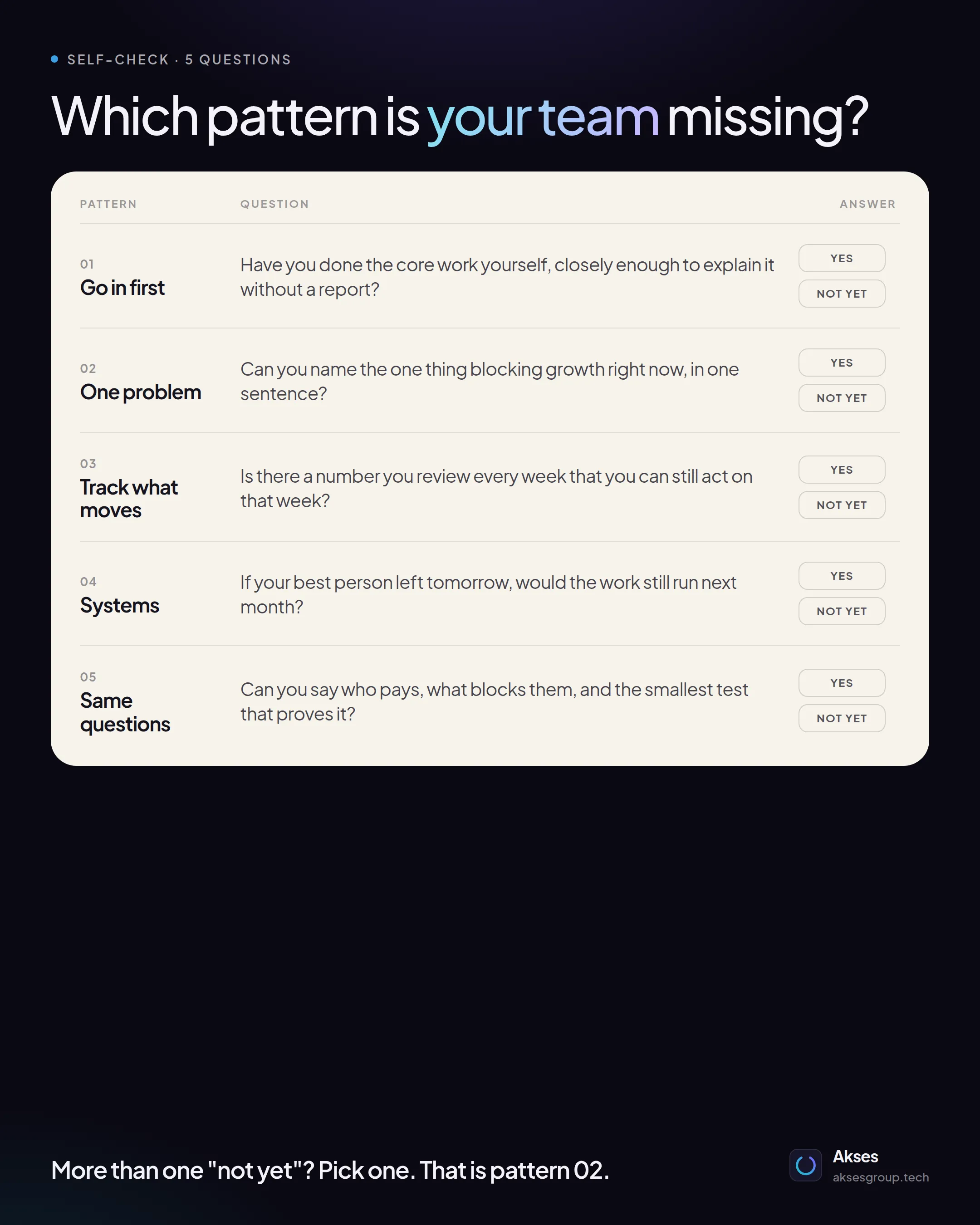
One question per pattern. Answer honestly, for your team or for one product.
0 of 5 answered yes
| # | Pattern | Question | Yes / Not yet | If not yet, start here |
|---|---|---|---|---|
| 1 | Go in yourself first | Have you (or the decision maker) done the core work closely enough to explain it without a report? | Spend a week inside the work: the front line, the customer, the process | |
| 2 | One problem at a time | Can you name the one thing blocking growth right now, in one sentence? | List every problem, cross out half, find the one the others depend on | |
| 3 | Track what moves | Is there a number you review every week that you can still act on that same week? | Pick one leading indicator (new customers, first experience, conversion) and review it weekly | |
| 4 | Systems outlast people | If your best person left tomorrow, would the work still run next month? And is there someone you already know is in the wrong role? | Write down how the critical work is done; set a date for the people decision you have been postponing | |
| 5 | Same questions | Can you say who pays, what blocks them, and the smallest test that proves it? | Answer the three questions on one page before spending more |
If you get more than one "not yet", do not try to fix all of them. Pick one. That is pattern 2.
06Closing
Closing.
I used to think every new industry would need a new way of working. It needed the same one, applied more honestly.
The products, the customers, and the numbers that mattered all changed. What decided growth stayed almost the same: get close to the process, find the one problem, watch the numbers you can act on, build the system, and ask the same three questions before spending more.
Maybe the point is simple. Experience in one industry is useful. The way of thinking built across many is what you actually carry.
The industry was different. The pattern was the same.
The product can change. The way of thinking travels.
This way of thinking is what we bring at Akses. Not a playbook for one industry, but the habit of going in close, finding what is actually blocking growth, and building the system that keeps the fix running.
Useful? Share it with a peer thinking about the same thing.
The 17 products and businesses come from the author's own work between 2016 and 2026, as a product lead, operator, or founder. They are described by category only; no company, client, or partner is named. Numbers are the author's own records for the specific product mentioned, not combined or extrapolated.
Akses · aksesgroup.tech